| Botanical name | Ficus benghalensis |
|---|---|
| Plant family | Moraceae |
| Fruit structure | Syconium: flowers enclosed within a fig |
| Typical ripe-fig colour | Red to orange |
| Root behaviour | Aerial roots can become woody supports |
Facts to start with
- The banyan is a fig, not a separate botanical family.
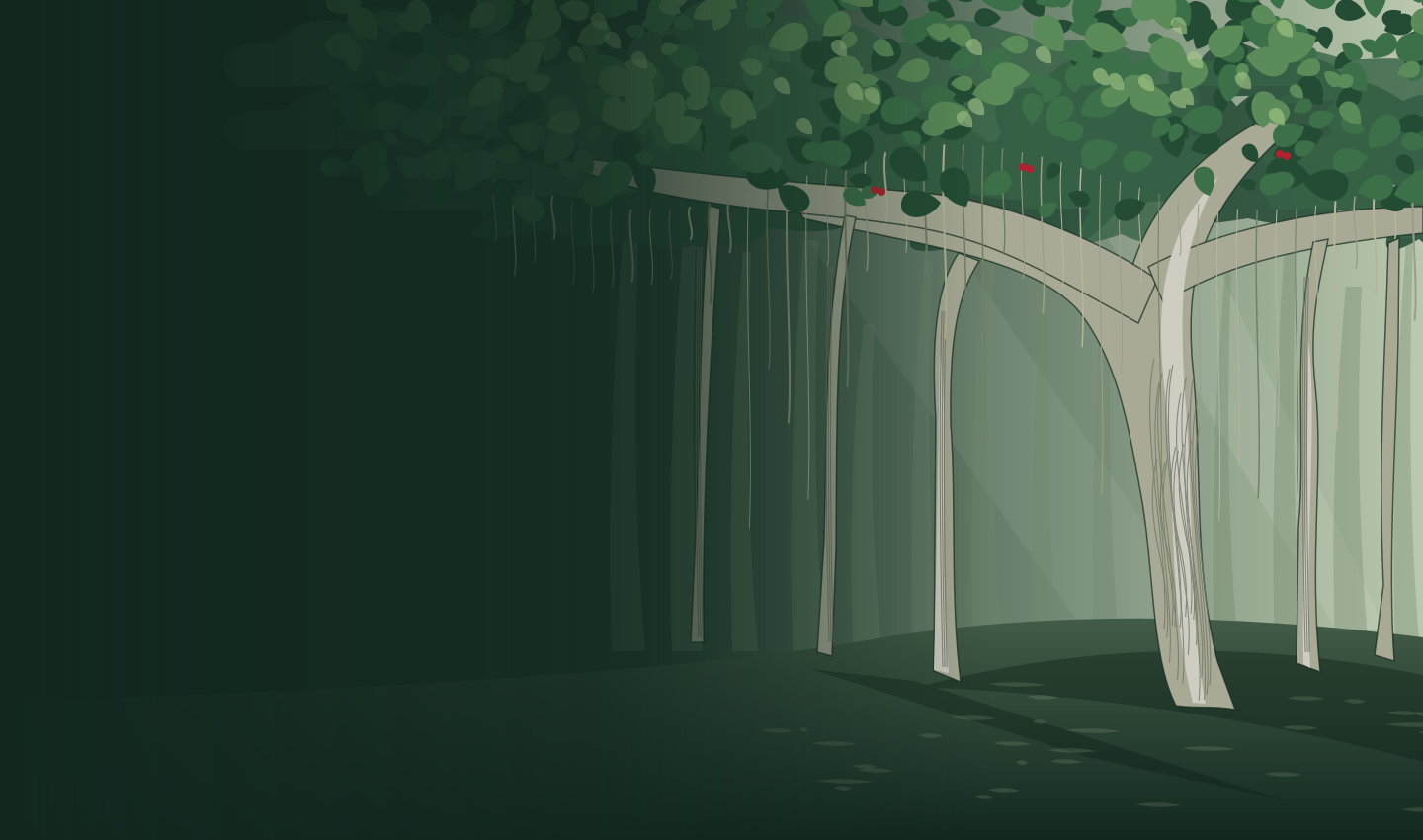
- Its conspicuous hanging structures are roots.
- A root that reaches suitable soil can become a pillar.
- A single crown can therefore be supported by many trunk-like structures.
- A seed may begin in a host-tree crevice before connecting to the ground.
- The flowers are inside a structure called a syconium.
- The Indian banyan’s associated pollinator is Eupristina masoni.
- Birds and other fruit-eating animals help move seeds.
- ‘Audrey’ is a cultivated form of Ficus benghalensis.
- The Bodhi tree belongs to a different species, Ficus religiosa.
What is the largest banyan?
The answer depends on what is being measured. Thimmamma Marrimanu is associated with a published canopy area of 19,107 m² (about 4.72 acres). Treat that as an attributed record, not a promise that the crown occupies exactly that area today. A living crown changes, and methods of tracing its outer edge differ.
A claim such as “four football fields” adds another ambiguity because football codes use different field sizes. Our canopy comparator shows the reference area used. The measurement ledger preserves source dates and disagreements instead of merging them into one confident-looking number.
How old can a banyan be?
Many celebrated trees have ages expressed as local tradition or estimates. An age repeated by many websites is not necessarily independently measured. A documented planting date is a different kind of evidence from a story about an ancient tree.
When you read a tree profile, look for the evidence type: planting record, historical reference, estimate or tradition. The continued survival of a multi-trunked tree also complicates the everyday idea of the “same trunk” ageing in place. There is no responsible single maximum lifespan to apply to every banyan.
Three easy mistakes to avoid
Do not transfer the mature size of a famous outdoor banyan to an indoor ‘Audrey’. Do not identify every tropical tree with aerial roots as F. benghalensis. And do not assume that a photograph of roots over a temple proves the tree is a banyan.
Start with the scientific name, then check the location and the date. Those small details prevent most of the errors that travel from one banyan article to another. For a simple introduction suitable for a classroom, see the banyan tree for kids.
Sources
- Ficus benghalensisNational Parks Board, Singapore · Accessed 2026-11-24
- Ficus benghalensis: banyanRoyal Horticultural Society · Accessed 2026-11-24
- Ficus benghalensis: species overviewUniversity of Florida / IFAS · 2026 · Accessed 2026-11-24
- Plants 400: Ficus benghalensisUniversity of Oxford · Accessed 2026-11-24
- The biggest tree canopy on the planet stretches across nearly five acresSmithsonian Magazine · Accessed 2026-11-24