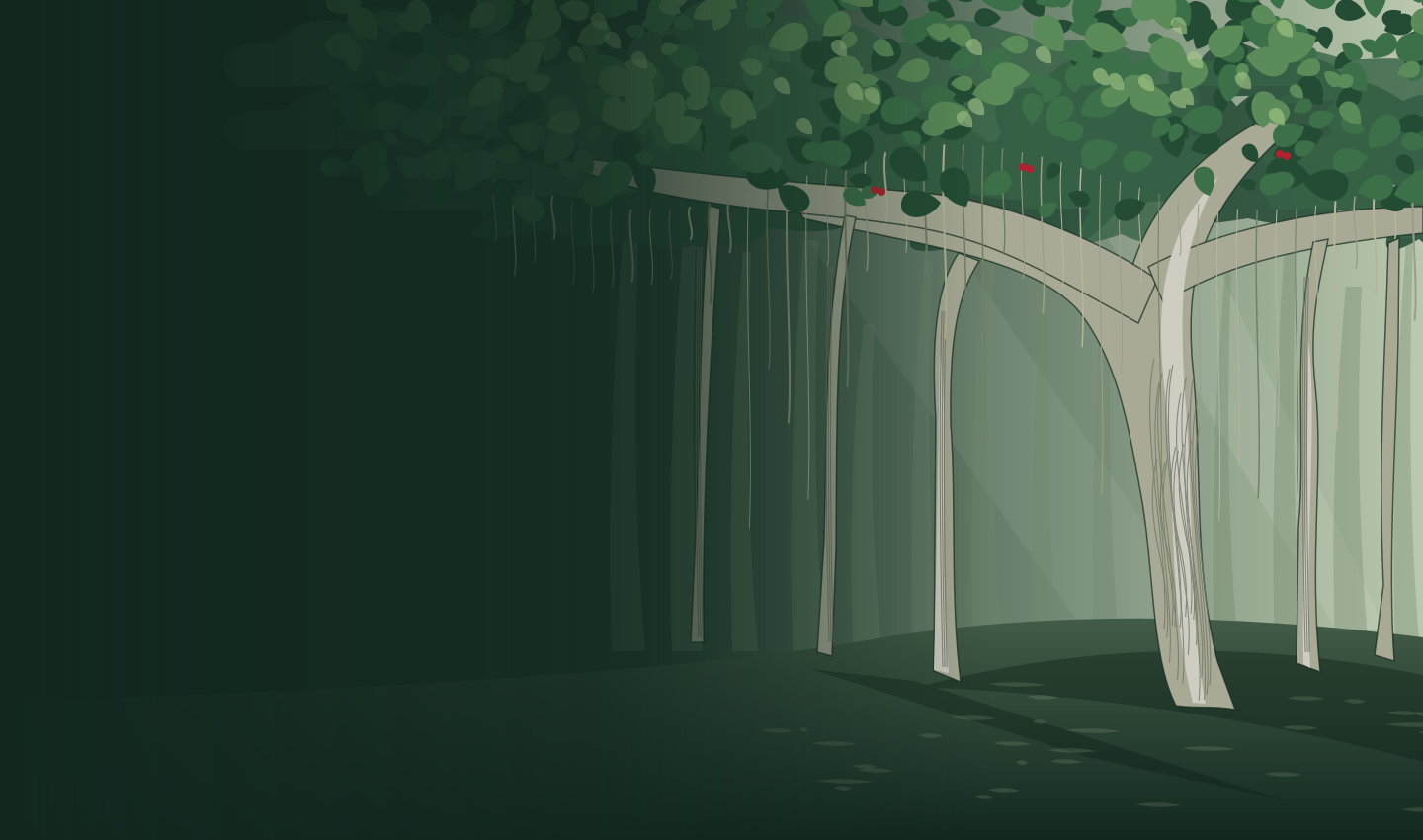
| Tree name | Indian banyan |
|---|---|
| Science name | Ficus benghalensis |
| What hangs down? | Aerial roots |
| What do they become? | Pillar roots |
| Where are the flowers? | Inside the figs |
Look up, look down, follow a branch
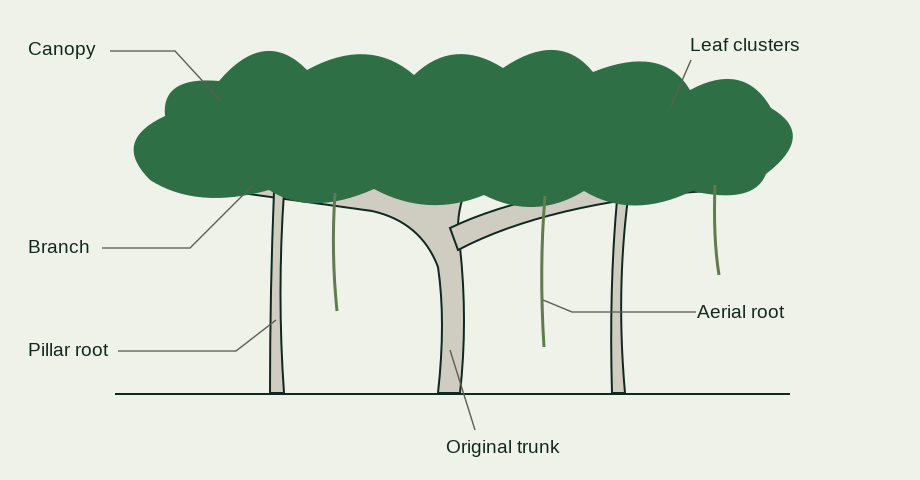
Imagine standing under a big umbrella with many handles. That is one way to picture a banyan. The spreading top is its crown. A thick main stem is a trunk. The long arms are branches. Roots growing down from those arms can make new supports.
The umbrella comparison helps us describe the shape, but a tree is alive. Leaves capture light. Roots take up water and help hold the tree in place. The branches connect different parts of the crown. A banyan does all of this while slowly changing its shape.
A seed with an unusual starting place
A bird can eat a fig and carry its seeds to another place. A seed may arrive in a tree fork. If conditions are suitable, it grows there and sends roots down towards the soil. Some figs eventually surround the tree they began on. This is called a strangler habit.
A banyan can also grow when people plant it directly in soil. It does not have to begin in a tree. Looking at two different banyans is a good reminder that living things do not all grow into identical shapes.
Make a field notebook
- Draw the whole crown before adding details.
- Mark one hanging root and one pillar that reaches the ground.
- Sketch a fallen leaf beside a ruler, if collecting is allowed.
- Write the location and the date of your visit.
- Record what you actually see, such as birds feeding or new root tips.
- Leave roots, bark, figs and wildlife undisturbed.
Use the classroom kit for a labelled diagram and a page to label yourself. Ask an adult before visiting a tree or handling plant material. Looking carefully is enough; you do not need to climb, break a branch or taste anything.
One question to take home
If you saw several pillars beneath one crown, how would you tell whether they belong to one tree? Follow the branches with your eyes. Write what you can trace and what you cannot. Good observation includes uncertainty.
The banyan atlas has examples from different places. Compare a young tree with a mature one, or a banyan with a different fig. The differences are part of the lesson.
Sources
- Ficus benghalensisNational Parks Board, Singapore · Accessed 2026-11-24
- Ficus benghalensis: banyanRoyal Horticultural Society · Accessed 2026-11-24
- Ficus benghalensis: species overviewUniversity of Florida / IFAS · 2026 · Accessed 2026-11-24
- Plants 400: Ficus benghalensisUniversity of Oxford · Accessed 2026-11-24